Vogue V1966 Muslin and Fitting
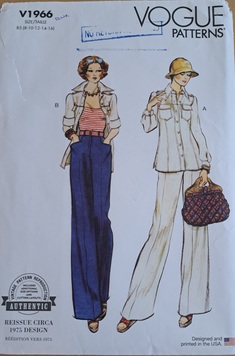
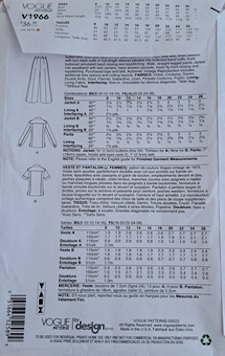
I picked up this vintage pattern during the Big Four farewell sale this past summer. I love 70s dagger collars, and I also had the perfect fabric already in my stash: a dark blue, floral babycord (originally bought for an abandoned overall shorts project), and remnants of deep purple Bemberg lining from so long ago that I cannot remember what I previously used it for.
I made a partial muslin (no collar) for view B with the length shortened about 4 inches through the torso so that the hem sat just a little past my natural waist. As a petite, fluctuating pear shape, I have started shortening ‘standard’ shirt patterns automatically to better suit my body type. I had no expectations when I bought this pattern that it would look the same on me as it did on the Willow Lady from the pattern envelope, she with legs in a 3:1 ratio with her torso; but, even so, my go-to adjustment felt like it lost too much of the style that I liked about this pattern in the first place. So, I made a second muslin without any length adjustments to start.
I completed the second muslin upto inserting the collar, leaving out the linings and buttons. Serendipitously, our local sewing guild had set up a fitting workshop with a nationally renowned designer, so I took my muslin in and got the benefit of an expert fitting assessment. The suggested alterations were:
- taking out about an inch from the top of the front yoke to pull the shirt forward and make it sit more centered on my shoulders (the shoulder seam had been falling behind the top of my shoulders);
- straightening the back armscye and reducing the width of the back yoke a little bit;
- removing some volume from the top of the sleeve cap;
- letting out the shirt from below the waist so that it wouldn’t pull tight around my hips.
I started with the adjustment to the front yoke, to get the fit right in the shoulders before making any other changes. I partly disassembled my muslin, then pivoted my existing yoke piece to reduce one inch from the height. I squared up the pattern lines on the new piece, re-sewed it to the back yoke, and tried the muslin on. The shirt sat much better now on the side with the fixed yoke, so I made the same change to the other front yoke piece as well.
I decided to tackle the fit through the body of the shirt next. The existing seams down the length of both the front and back pieces provided a natural place to add some volume. I unpicked them upto the top of the side slit and then basted small strips of fabric in the gaps to determine how much volume to add. After some experimenting, I landed on an addition of 1.5 inches tapered out to the bottom of each of the back seams and left the front pieces unadjusted. The extra room in the back was enough to fix the pulling issue, and I liked the profile of the shirt better with this distribution of volume than with volume added evenly all around. Satisfied with the lower torso width adjustments, I then pulled in each of the back seams by about half an inch from above the waist, to give a sleeker profile in the upper back. This last adjustment also reduced the width of the back yoke by about one inch in total.
Then came the sleeves. Muttering, ``Forgive me, I simply do not know what I am doing,’’ 1 to my muslin, I tested two different approaches to the sleeve adjustments, one on each side of the shirt. On the right side, I deepened the armhole by about half an inch, and eased the sleeve into the extra circumference, effectively (or, ineffectively, I’m not sure) flattening the cap. On the left side, I kept the armhole the original size, reduced the width of the sleeve by pinning a one inch tuck down the length of the sleeve, then eased the sleeve cap into the armhole as usual. I liked the look and movement of the left side adjustment more than the right, so I decided to go with that approach.
As I had been making these adjustments, my mind had kept wandering back to the question of length; the more I improved the fit, the more the flowy spirit of the shirt seemed to be emerging / merging with my frame, and I felt like I could try shortening it now without losing the look that I had wanted. Centering my adjustments on the waistline to minimally impact the side slit and back contour, I pinned out 4 inches of length across the body and tried it on. Then I pinned out 2 inches across the body and tried that on. I really liked both versions. Considering what would look best with the fabric I had picked out, I settled on the 2-inch length adjustment.
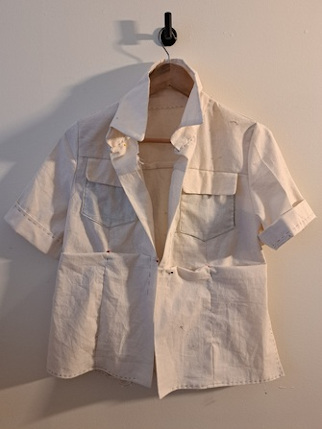
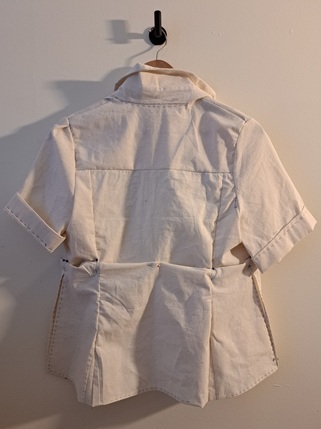
So now, with all of the adjustments implemented, the next step is to mark the finalized seamlines and then disassemble my muslin once again to convert it into new pattern pieces. After that, I will test the adjusted pieces with one last(?) muslin before I cut into my precious babycord.